In a similar way to a find-a-word or word search, a word clock is an ornament which uses a grid of letters to display the time. The clever arrangement results in the 144 combinations required to display the time in five minute intervals.
The Large Word Clock
The front face is glossy and flat to achieve an exquisite modern look to this innovative clock. Designed to be mounted on a wall or rested on a shelf, the time is displayed bright and clear, readable in any light.
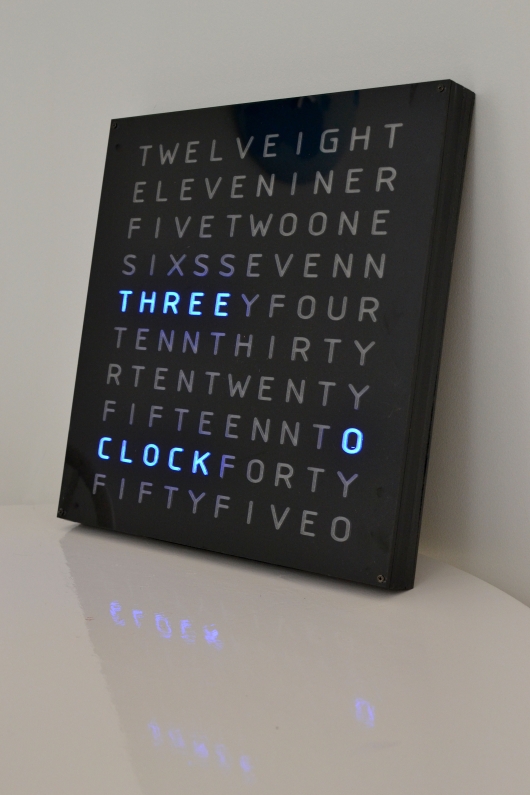
Each letter is recessed into the back of the bulletproof perspex acrylic by precisely 3mm to give the appearance depth to the glowing, floating letters. The individual characters are separately lit and capable of showing millions of colours.

The Small Word Clock
Designed to be set on a desk, the small word clock is an enviable decoration. The simplicity of its appearance gives any desk a contemporary look and provides an interesting conversation piece.
Using the same multi-colour illuminations the small clock is every bit as stunning as the large version. Letters are smaller than on the large clock but maintain the same back-engraved, floating impression.
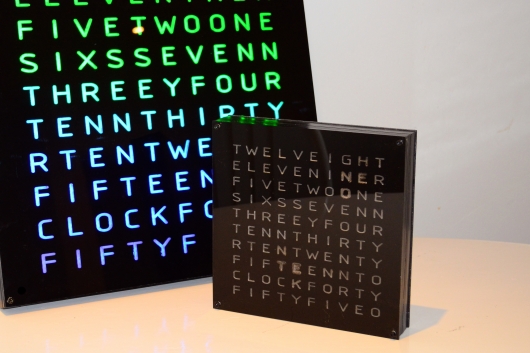
The prototype Small Word Clock shown above.
The Word Patterns
The modes are switchable via a button on the side of the frame which cycles through the various styles. The following standard patterns come with every word clock.
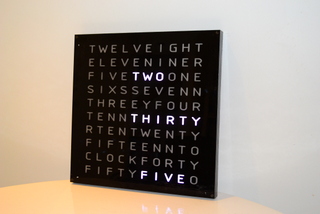


Test pattern
For contributors who choose to sponsor the project, every $5 over the base price of the reward the supporter gets to choose an additional word clock pattern from the options below.


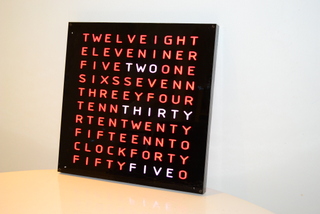
or a choice of the animated patterns:
Or request a pattern in your corporate colours or to match your exact decor.
Building objects of beauty is a labor of love which one day I hope to be able to turn into a viable business. To do this I need to start somewhere and this project will be a good place to start.
I have included the extended bill of materials below to demonstrate the materials, tooling and effort that goes into producing one clock.
Bill of materials (large and small)
100x WS2812b LEDs
1x Front perspex panel
1x ATmega32u4 Microcontroller
1x DS2321 RTC
1x MDF for light screen
1x MDF for back
1x Light diffuser layer
8x Screws for back
4x Screws for front (possibly black recessed allen type for final versions)
3x Tactile buttons
2x DC Jack
1x 5v 1A DC Power Supply
1x Black coating for perspex
Manufacturing, tooling & consumables
4h CNC time per clock
1h Electronic assembly
1h Finishing and testing
3mm downcutendmill (large letters and mdf)
1mm TiAN endmill (small letters)
Mastercam Licence
GWizard Feeds and speeds calculator
Autodesk Inventor Licence
Pozible fees
Credit card processing fees
Packaging & Documentation
A4 Page & Printing for Manual
Cardboard box for shipping
Packing foam
Shipping
Depending on location.
Profits
If the project meets its funding goals anything left over from the materials and manufacturing will be directly reinvested in the workshop and tooling for new and exciting projects. If the project turns out to be wildly successful it may allow me to lease a dedicated workshop and be more adventurous on the next creative project.
About the manufacturing process
CNC manufacture
The signature 'floating letter' effect of these clocks is achieved through precision CNC milling from the back of the perspex.

To achieve a crisp and smooth finish the process takes time and requires specialty cutting bits which are sharp and well maintained. The backing of the letters to channel the light is also milled autonomously for a perfect fit to the front panel and a pleasing even effect to the light.


All manufacturing for this project is going to be done in-house. This allows quality to be tightly controlled and allows investments of time to also count as a learning experience.
Code, electronics and QA
It doesn't seem like experience in mining and agricultural control systems counts for much when it comes to a wall clock but it is very important to have safety and reliability in an appliance running 24x7. The code is structured to be robust to erroneous data and the electronics are designed to withstand interference. This means that your clock should continue to run into the future and always be on time. Additionally, my background is always on delivery-focused projects. I am determined to deliver the expected results on time.
Setting time & switching patterns
The time of the prototype is currently set by downloading code to the microcontroller. It's not an issue to set this with a series of buttons but it's a feature which still has to be completed. The final versions will likely use two buttons to set the time with a simple hours/minutes method. In a similar way, the patterns will be switched by pressing a 3rd button.
Power connectors
The prototype has a single connector which works fine for setting the clock on a table, however, you may want to hang it from the wall and hide the power connector in a different position. The planned solution for this is to mount multiple power connectors around the frame. A battery version is possible but would not last long enough to be practical to read the time from during the day.

Wall mount with hidden cabling.
Brightness calibration
The letters are bright and clear but perhaps a little too bright for a dark room. The possible solutions for this are to either include a button to set brightness or a sensor to adjust the levels automatically. The plan is to test both solutions and the final solution may be a combination of both.