Update (September 22): Celebration Time! Target Reached! We're excited, overwhelmed by the love and support and feeling humbled. And there is still six days to go! In fact, we're so excited that Talking ecoLogical is going to be printed that we have a final week half price offer: The $2000 reward is now $1000. Check it out! Tell everyone! And remember you can still preorder your set of cards here through Pozible for another 6 days.
What is this project?
Innovative Resources--a not-for-profit publishing house--wants to publish a brilliant NEW conversation-building card set created by Ian McBurney for the journey to ecological sustainability. The product is called Talking ecoLogical. It's finished and ready to go and we need $8,000 to print and let them loose on the world. The printed set of 37 cards will come with an instructional booklet.
Do you struggle to talk about sustainability in your workplace or community? If so, this card set will be a great resource for you and your work.
"Truly Brilliant"
- Paul Hawken, environmentalist, entrepreneur, journalist, and author.
A Talking ecoLogical sample ...



Update: The Cards in Action in Melbourne August 2013
Talking ecoLogical in action ... from
Ian McBurney on
Vimeo.
What makes up the physical card set?
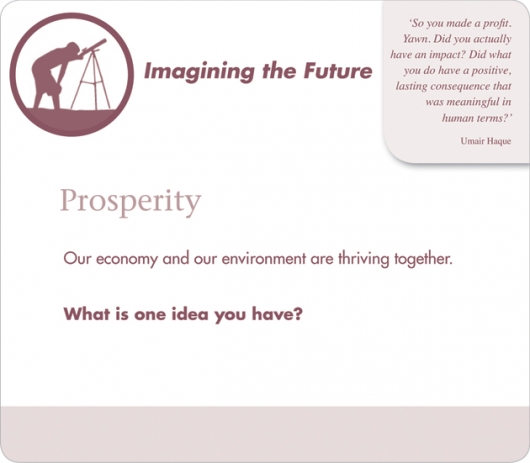
Talking ecoLogical consists of thirty-seven conversation-building cards arranged into four suits.
Each card has the following elements: the name of the suit, a topic heading, a referenced statement, a question and a quote.
Each element on the cards is intended to offer a prompt and add richness to the discussion. A user of the cards may be drawn to one or more of these elements—and the facilitator can invite people to focus on a particular element, or a particular sequence of elements, if desired.
The four suits
The name of the suit gives participants a broad context for the discussion. The four colour-coded suits are:
Elements of Identity. Five cards. Blue.
Imagining the Future. Ten cards. Burgundy.
The Challenge. Seven cards. Orange.
Processes of Change. Fifteen cards. Green.
The topic heading
Each of the 37 cards features a topic heading to provide a clear focus for the discussion. This may be a single word such as ‘Belonging’, ‘Consumption’, ‘Economy’, ‘Dreaming’ and ‘Transport’; or it may be a phrase such as ‘Guide beside’, ‘Ten-year plan’, and ‘Quiet times’. The topic heading on each of the five cards in the ‘Elements of Identity’ suit is a whole sentence for example, ‘We are water’, and ‘We are life’.
The referenced statement
During the development of the cards, we experimented with removing some of the elements on the cards to see just how minimal they could be, but we found that a certain level of nuanced input greatly improves the confidence of participants in building conversation. For example, many of us are new to some of the topics of sustainability covered in the cards (such as ‘biomimicry’) so the referenced statement beneath each topic is there to provide some simple, easily-understood information about the topic. Participants can use this information as a springboard for discussion.
The question
To spark the conversation even more—there is a question beneath each statement. As the ‘Curiosity’ card suggests, we think questions are often more powerful change-makers than answers. And, as our perspective changes, the same question can elicit a different response at different times, so re-visiting a question many times is a very fruitful practice. There are, of course, many questions that could be asked for each card. After countless hours of discussion and consideration, we landed on what we hope is an intriguing question that will provide a powerful window into the topic. Taken across the whole set, you will find an array of questions that invite reflection and conversation about meaning, choices, definitions, steps forward, ideas, observations, values and plans—to name but a few. Please feel free to frame your own questions.
The quote
I have been a ‘collector of inspiring quotes’ for many years. The quotes on the cards have been chosen because I think they are intriguing, uplifting and spot-on and, in most cases, because the person is a world-leading thinker in their field. The quotes open yet another interesting window into the topic or illumine the question in different way. Sometimes a participant may respond to the quote more readily than any of the other elements, or the quote may give them a clue about the meaning of the topic or another way of thinking about the statement. In this way, all the elements can build on each other and add layers to the conversation.
How can you help?
We need your help to bring this great new conversation-building tool to the world. There are two ways you can show your support and get involved:
1. Contribute financially. Check out the the rewards at right:
2. Share the project on twitter, facebook, via email and in conversation
How will we spend the money? It's quite easy. If we raise $8,000 we do a first print run of cards.
After that it gets a bit more exciting. If we go past our fundraising goal we could create a schools' version, do a larger print run, create some funky online animations and instructional videos and boost our marketing drive once printed.
Project Background
The first version of these cards was created for a workshop I ran in 2007. They were hurriedly put together, had gaping holes, looked horrific and were grammatically terrible, but the funny thing was that the people loved them. They loved being able to have a conversation about sustainability rather than being lectured to about it. They loved how our impacts on the earth were given equal weight in the conversation to change practice. They loved imagining what a sustainable future might be. Best of all they loved talking about the whole issue with each other. Together, when left to their own devices, they understood sustainability and what needed to change. The cards encouraged them to articulate their understanding.
I thought I might be onto something. In my experience humans get sustainability, but our institutions do not. Globally, governments have been very busy failing to agree on how to fix our environmental problems for over thirty years. Yet whenever I work with real people in manufacturing, communities, schools and local government, they all seem to get it: Respect each other. Respect the place. It ain’t rocket science.
I think there are three reasons why we haven’t yet created an ecologically-sustainable society.
Firstly, we still haven’t imagined what a sustainable future is. What is it like to live in an ecologically-sustainable world? What would the economy be like? What would it feel like to walk around in such a world? What about other benefits like health, wellbeing and community? Is a sustainable future a better place to be?
Many of us have changed the light bulbs and done the other little things, but we haven’t yet changed our dream. We’re still buying into the ‘consumption = success’ thing, even as the evidence mounts against it.
Secondly, I believe that a lot of people—many older, powerful business people amongst them—still subscribe to the outdated idea that ‘environment’ is anti-progress. With a global green economy of $7 trillion, the growth of the sharing economy, renewable energy, carbon pricing, sustainable design, fair-trade and the world-wide push towards energy-efficient housing, cars and appliances, the ‘direction’ of the economy has shifted. Yet governments worldwide are propping up the old economy; funding freeways, banning wind power, subsidising fossil fuels, bowing at the temple of economic growth and turning sustainability into wickedly complex policy and dumbed-down rhetoric. So whilst individual people understand the need for change, our institutions are holding back the wave of change.
Thirdly, we think the answers are about information and technology when change is about people and culture. The key, I believe, is to change our culture. The building blocks of culture are connection, interaction, participation and conversation. I would argue that these are skills we have been losing as we tune into screens, sit in cars, live in more private houses and work in hierarchical organisations.
In 1999, fresh out of environmental engineering I landed a job working on a sustainability business project with twenty-five automotive manufacturers in northern Melbourne, Australia. I loved the factories and their community, productivity, challenges and work ethic. They were all Mums and Dads like the rest of us. Safety, Quality and Occupational Health and Safety were all the rage and they were brilliant at using these tools to improve their businesses. ‘Environmental impacts’ were just beginning to come into focus. We helped them with all the ‘little things’. They recycled, they switched off lights, they changed cups, they improved processes, they put together registers of all their ‘environmental impacts’ and they all saved money. The funny thing was they were all still making V8 cars, management never heard about sustainability and when the passionate or informed people left, so did the progress. Where was the vision? Where was the plan? Where was the transformation? Renowned corporate responsibility and sustainable development expert John Elkington, has likened our sustainability progress to moving the deck chairs on the titanic, whilst accelerating towards the ice berg.
Imagine if the car companies had taken their small sustainability steps and used them to re-imagine their business model and their products. Car sharing, pooling and swapping; electric vehicles; hybrids; smart car technology; sustainable design; recyclable, non-toxic materials and alternative fuels would all be common practice now.
Our institutions and our politics are, I believe, largely ecologically illiterate. Politicians talk about saving whales and reducing plastic bags whilst approving new coal mines. CEOs add a workplace tree planting day to the back cover of a financial annual report and call it their social and environmental bottom line. Local councillors talk about the ‘balance between protecting the environment and development’ as if they are in a mutually exclusive fight that the environment regretfully has to lose. The media still trumpet money, power, fame and consumption as contiguous with success.
And then there is the media hype around single issues. Solar panels, climate change, plastic bags, orang-utans and water tanks all are really important, but there is so much more to creating a sustainability-led economy and society than that. The topics raised in all 37 of the cards in Talking ecoLogical attempt to widen the scope of this conversation and are all of equal importance in my opinion.
We are coming to realise that creating a sustainable future requires us to change much more than the light bulbs. We need to change almost everything about who we are. But it’s not about living in a dingy cave; it’s about making life better than it ever was. More liveable homes, communities and cities. Healthy buildings. Networked and local energy, food systems and economies.
My hope is that the conversations arising out of using this card set will help us to move to a place where we can be driven by the urgency of our challenges AND the beauty of our dreams ... and, along the way, be buoyed by the social connectedness that comes with positive cultural change for sustainability.
Ian McBurney
Sustainability practitioner - MC, Speaker, Educator, Business Mentor, B.Eng.Env
Author of the Talking ecoLogical card set
Thanks! And stay in touch!
Please connect with Ian and the project via:
Twitter:
www.twitter.com/talkingecological or
www.twitter.com/liveecological
Facebook:
www.facebook.com/talkingecological
Website:
www.ianmcburney.com
Linkedin:
http://www.linkedin.com/in/ianmcburney
Email:
[email protected]
And finally, a huge shout out and thankyou to the brilliant Haven (http://www.lmhs.com.au), where I sit at the Synergize coworking space and where the video was filmed.
Please connect with Innovative Resources and the project via:
Facebook:
https://www.facebook.com/Innovativeresources
Website:
http://www.innovativeresources.orgPhone: (03) 5442 0500
Newsletter:
http://www.innovativeresources.org/Pages/Join_Our_Mailing_List.aspx
Email:
[email protected]
Once printed, we have marketing and distribution challenges to overcome. Innovative Resources have a wealth of experience in this regard, having published hundreds of similar card sets. A marketing plan has been prepared to promote the product to facilitators, sustainability networks, business, community groups, schools and conferences.